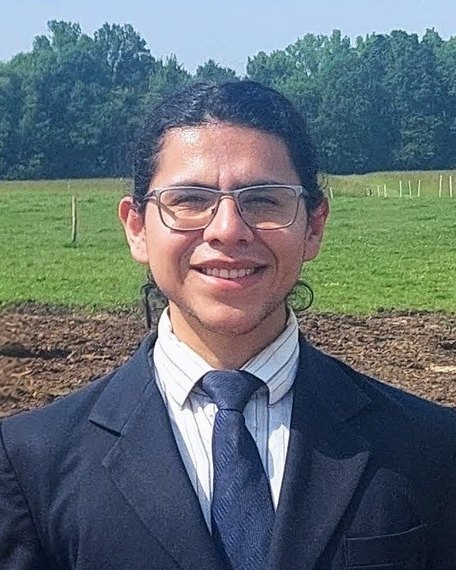
About
I obtained my PhD in 2026 from Virginia Tech under the supervision of Eric Sharpe, and am now a postdoc in the Mathematical Structures in Physics group led by Daniel Roggenkamp at the Max Planck Institute for Mathematics in the Sciences (MPI MiS) in Leipzig.
I am interested in stating physical structures, such as symmetries and their anomalies, precisely enough to prove theorems about them, and in letting that precision suggest new physics and new mathematics.
Research
Generalized symmetries
Higher-form and non-invertible symmetries of quantum field theories, their gauging, and their anomalies.
Symmetry TFTs
Using SymTFTs and multi-fusion categories to organise the symmetry data of a theory.
Decomposition
How theories with certain symmetries split into sums of simpler universes.
Higher geometry
Cohesive and higher-categorical methods for gauge theory and sigma models.
Papers
-
2026
Topological interfaces between universes and generalized families of 2d QFTs
-
2026
Magnetic Higher-Form Symmetries as Dual Fundamental ∞-Groupoids
-
2026
Notes on (−2)-form symmetries
-
2025
Higher-form symmetries as higher automorphism bundles
-
2025
Total instanton restriction via multiverse interference: Noncompact gauge theories and (−1)-form symmetries
-
2025
Categorified structures over moduli spaces: Anomalies, non-invertible symmetries, and exceptional holonomy
-
2025
Anomaly resolution by non-invertible symmetries
-
2025
Decomposition in 2d non-invertible gaugings
-
2024
Notes on gauging noninvertible symmetries, part 2: higher multiplicity cases
-
2024
Discrete torsion in gauging non-invertible symmetries
-
2023
Notes on gauging noninvertible symmetries, part 1: Multiplicity-free cases
-
2023
Three-dimensional orbifolds by 2-groups
Talks and visits
-
Nov 2026
HEP – QFT Seminar, Universität Leipzig · “A geometric approach to higher-form symmetries” ·
-
Nov 2024
Southeastern Regional Mathematical String Theory Meeting, Duke University · “Discrete torsion in gauging non-invertible symmetries” · slides
Miscellaneous
Outside physics, I am interested in philosophy and theology, above all Aristotle, Saint Thomas Aquinas, Søren Kierkegaard, and Joseph Ratzinger. The topics that draw me most are natural philosophy and ethics in the Aristotelian–Thomistic tradition, the relation between faith and reason, and the philosophy of mathematics and its bearing on physical reality.
I am also drawn to Christian mystical theology, particularly Saint John of the Cross, read through Saint Thomas as Réginald Garrigou-Lagrange does, and Saint Edith Stein, whose work brings phenomenology and Thomism into conversation with the Carmelite tradition. More broadly, I am interested in the different apostolic Christian traditions, especially the Latin and the Syriac: what the Syriac Fathers, from Saint Ephrem to Saint Isaac of Nineveh, have to offer alongside the Latin inheritance of Saint Augustine and Saint Thomas.
I am curious, too, about other religious traditions and how they meet Christianity, from Zoroastrianism and Manichaeism to Islam, Jewish mysticism, Daoism, and the thought of Islamic philosophers such as Ibn ʿArabi, Ibn Rushd, and Ibn Sina. Closer to home, I am drawn to devotion to Our Lady and to the Blessed Sacrament, and to their place in the interior life.